
Both the eccentric semi-ball valve and the V-type ball valve are ball valve products with good performance, reliable sealing, anti-blocking and siltation resistance. However, there are certain differences in actual use. As a large global valve manufacturer, Farpro Yuanda Valve will introduce you in detail to help you choose and install the most suitable ball valve for your project.
The eccentric semi-ball valve belongs to the cut-off valve category, which is mainly used to cut off and connect the medium flow in the pipeline. Because of its strong flow capacity, small flow resistance, fast opening and closing, long service life, and bidirectional sealing, online maintenance and cutting functions, it has obvious advantages compared with the gate valve, stop valve, butterfly valve, and ball valve in the cut-off valve category, especially in the working conditions of high flow rate, large diameter, high pressure, sewage and sediment. It is its replacement product and has been widely used in many water plants, power stations, steelmaking, mining and large-scale water transmission projects.
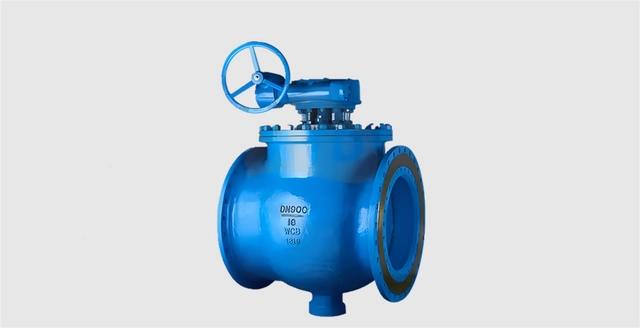
Structural features of eccentric hemispherical valve
- Small resistance and low energy consumption: The straight-through full-channel wedge-type eccentric design structure makes the flow channel completely unobstructed after opening, and the open flow path can reduce flow resistance, which can save a lot of energy.
- Reliable automatic compensation seal: When the valve gate is under positive pressure, the ball and the valve seat are closed more and more tightly by utilizing the principle of eccentricity, and the sealing effect is good. When the valve gate is under reverse pressure, the floating valve seat is automatically pushed against the ball under the action of the medium. The higher the pressure, the better the sealing effect; after long-term use, the valve seat seal is worn, and the valve seat is automatically pushed against the ball under the action of the spring, which has a good compensation effect.
- Automatic cleaning and dredging function: The edge of the ball crown is provided with a blade-like structure, which can not only scrape off the medium dirt on the valve seat, but also cut off the debris brought by the medium.
- Resistance to sediment accumulation: The upper and lower valve shafts of the vertical eccentric hemispherical valve are in the middle of the flow channel, and sediment will not accumulate on the valve shaft. The bottom of the valve of the horizontal eccentric hemispherical valve adopts a flat-bottomed hemispherical design, which will not cause sediment accumulation.
- Suitable for high-velocity media: Because the ball is hidden on one side of the valve cavity, a straight-through flow channel is formed without flow resistance. Noise and vibration also depend on flow velocity, pressure drop and the selected valve configuration.
- Maintenance access: Serviceable parts and access arrangements depend on the model. Compare the replacement seat, seal and ball-segment options when planning maintenance. Isolate and depressurize the valve before opening it, following the manufacturer’s maintenance procedure.
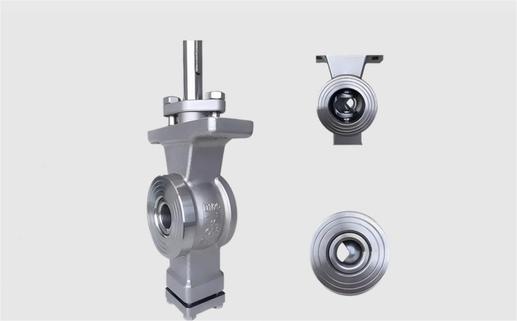
The valve core of the V-type ball valve also adopts a hemispherical structure. The key point is that there is a V-shaped opening on the valve core. The V-shaped opening can control a smaller flow rate, and its flow capacity is larger than that of a general regulating valve. Therefore, its adjustable ratio is far greater than that of ordinary regulating valves. However, the sealing surface of the ball core of the V-type ball valve is always in close contact with the valve seat. The valve shaft and the center line of the hemisphere are at the center line of the flow channel, while shaft and seat geometry depend on the particular design. The V-type ball valve is a valve with a V-shaped opening on one side of the hemisphere valve core. By adjusting the valve core opening, the cross-sectional area of the medium flow is changed, and the flow rate is adjusted. It can also be used for switch control to open or close the pipeline. It has a self-cleaning effect, and can adjust a small flow rate within a small opening range. The adjustable ratio is large and is suitable for media containing fibers, fine particles, and slurry.
Similarities
- Both use rotary spherical sealing surfaces. Their handling of fibers or particles depends on the selected passage, trim and operating conditions.
- Both use a fixed ball method, and the ball core is fixed.
- Both can be connected by flange or clamp.
Main differences
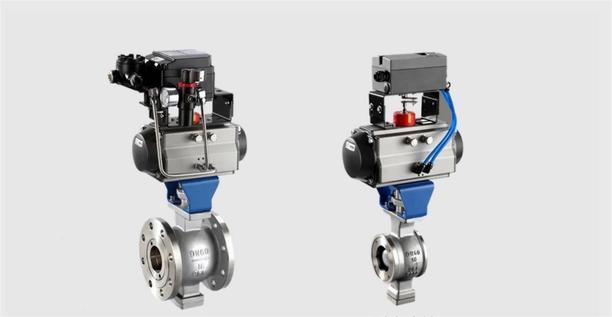
- The valve core is different, and the eccentric hemispherical valve does not have a V-shaped opening on the ball surface. The V-shaped ball valve has a V-shaped mouth on the spherical surface. The V-shaped mouth can obtain smaller flow control and bring better shearing ability, which is suitable for medium containing fibers.
- Maintenance: Compare which seats, seals and ball or segment parts can be replaced on the offered model. Repair scope and cost depend on that construction, rather than the valve family name alone.
- Operating duty: State whether the valve is for isolation or continuous regulation. For a control duty, compare the offered model’s flow characteristic, flow data and actuator/positioner arrangement; a generic rangeability ratio is not a specification for every valve in either family.
- Size range: Available sizes vary by manufacturer and model. Confirm the required line size and the offered configuration instead of treating a generic DN limit as the boundary between these valve types.
- Eccentric semi-ball valves adopt side-mounted or top-mounted structures. V-shaped ball valves are mostly side-mounted structures.
Finally, there are many types of valves, and each valve has its own unique characteristics and scope of application. When selecting and using valves, it is necessary to comprehensively consider factors such as the actual needs of the project, medium characteristics, and working conditions to ensure that the valve can fully play its role and ensure the safety and benefits of the project. As a large global valve manufacturer, Farpro Yuanda Valve can certainly be a competent assistant and a trustworthy partner in your project.
Bring the Application into the Comparison
Two offers can look similar until you compare what the valve must do. For a replacement, send the existing model or nameplate and explain why it is being changed: leakage, wear, blocking or a change in process duty. For a new line, start with the fluid, size, pressure, temperature and whether the valve will isolate or regulate the flow.
For the control side of the choice, read our V-port ball valve guide. If the requirement is simply to open and close the line, compare the existing Q41F floating ball valve configurations as a separate isolation option. A change of valve construction still needs the materials, connections and operating duty checked.
Send Farpro your application and quantity, along with the destination. A short description is enough to start; the quotation can then address the required construction and operation instead of relying on a valve family name.